
When we started developing portable solar tracking concepts a few years ago, the ecosystem looked quite different. Panels like the Jackery SolarSaga were leading the portable market, relying on SunPower cells for high performance.
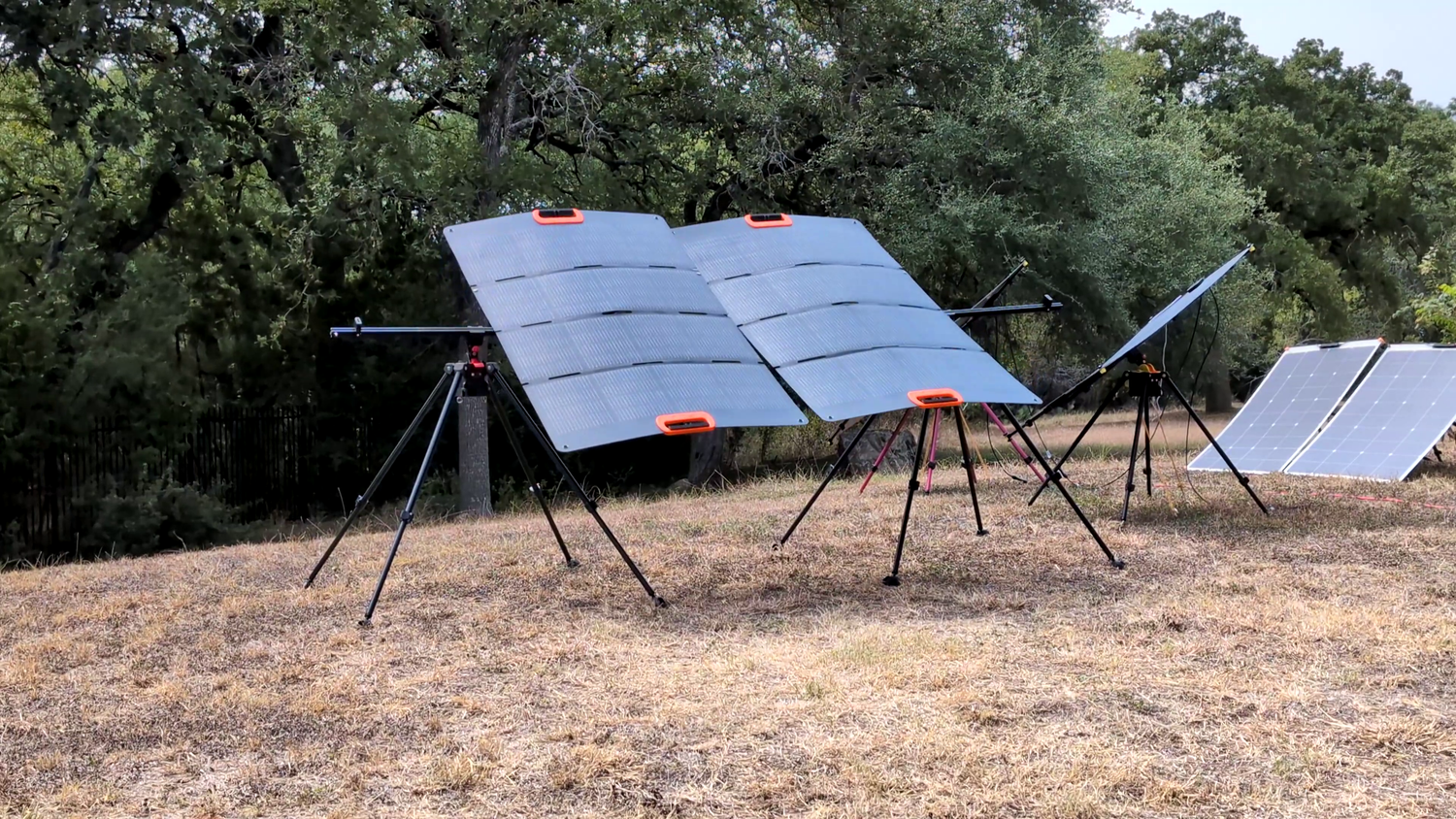
Over time, we expanded our ecosystem by introducing our own panels alongside custom carriage-adapters. Available in two sizes, these adapters allow users to mount third-party rigid or flexible panels—provided they fit the weight and dimension requirements and include robust corner eyelets.
Mounting a single 200W flexible panel or blanket onto a tracking system already captures significantly more energy throughout the day than laying the panel flat on the ground. But as energy demands grow, the natural question becomes: How do we scale power capacity without compromising system stability?
The Torque vs. Wind Loading Challenge
With the pSolBot R2, we doubled the gearbox torque compared to the original pSolBot 1. That extra torque easily handles heavier payloads, enabling setups like our previously published tandem carriage concept, which mounts two panels for 400W of installed capacity.
However, mechanical payload weight is only half the equation. The real challenge at higher power levels is wind loading.
When you double the surface area on a single portable base, wind forces introduce substantial dynamic loads. Rather than making a single ground unit larger, heavier, and less portable, a far more resilient engineering path is to link two portable systems together.
How Tightly Coupled Systems Work
To achieve an 800W setup using 4x 200W flexible panels, two pSolBot R2 units must operate as a unified system across two distinct domains:
-
Software Synchronization: The two units establish a wireless link, elect a primary controller, and coordinate all subsequent movement vectors synchronously.
-
Mechanical Tolerance: Because real-world terrain is rarely flat, a completely rigid link would transfer harmful bending moments to the frame. Incorporating a ball joint tolerance link at the connection point allows the common beam to absorb ground variations while maintaining structural integrity.
Properly anchored, a paired dual-machine setup provides a significantly broader, more stable footprint than a single overloaded tracker.
The Broader Picture: Coordinated Robotics in the Field
The concept of multiple machines working in tandem isn't unique to solar tracking—it’s a foundational pillar across modern field robotics:
-
Drone Swarms & Aerial Surveying: In agriculture and search-and-rescue, multiple drones coordinate flight paths to cover large surface areas faster, automatically adjusting positions relative to wind and terrain.
-
Autonomous Agricultural Equipment: Modern tractors and harvesters often work in "leader-follower" configurations, where one primary autonomous vehicle dictates the path for secondary units to maximize field efficiency.
-
Coordinated AMRs (Automated Mobile Robots): In logistics and heavy manufacturing, multiple small mobile robots physically connect or coordinate to move payloads far beyond the lifting capacity of any single machine.
By applying these same multi-agent coordination principles to portable solar generation, we can keep individual components lightweight and manageable while unlocking higher system-level capabilities when needed.
Looking Ahead
This dual-bot 800W setup is an early-stage prototype, and there is still substantial software hardening and structural refinement required before a commercial release. However, testing multi-machine coordination opens up exciting possibilities for modular, scalable off-grid power.
We’d love to hear your feedback on this approach. Do you see value in modular, multi-machine tracking for high-output portable setups?
To explore the pSolBot R2 architecture and follow our ongoing hardware tests, visit SolarPivotPower.com.



Leave a comment
This site is protected by hCaptcha and the hCaptcha Privacy Policy and Terms of Service apply.